
 +86-13599204288
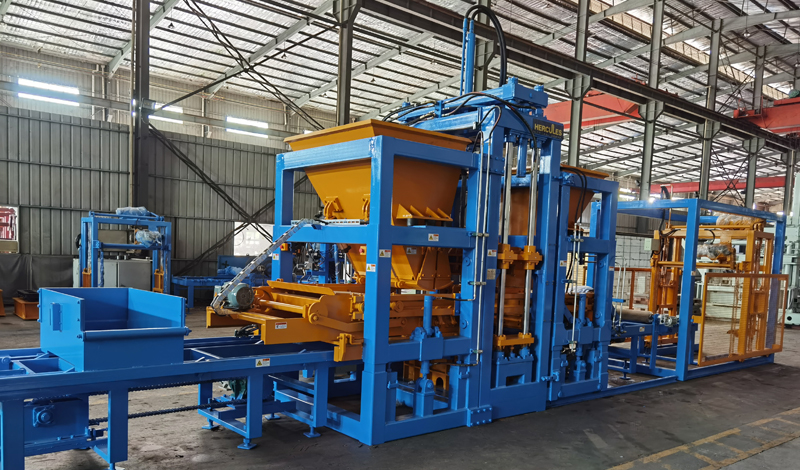
In a modern building materials production workshop, a fully automatic non-firing brick machine with blue and orange color scheme stands quietly. It is not only a masterpiece of industrial design and mechanical manufacturing, but also a key piece of equipment driving the transformation of the traditional building materials industry toward environmental sustainability. With its high efficiency, intelligence, and eco-friendly features, this machine has redefined the standards of brick production, providing solid support for urban construction and ecological protection.
I. Equipment Structure and Core Design
This fully automatic non-firing brick machine adopts a modular integrated design, consisting of four core modules: the main forming unit, material feeding system, palletizing system, and control system. The blue-and-orange color scheme not only highlights a sense of industrial power but also clearly demarcates functional areas.
• Main Forming Unit: The blue frame structure on the left side of the machine is the core forming unit, featuring a four-column guide design. Combined with hydraulic drive and vibration systems, it provides uniform pressure and vibration to the brick blanks, ensuring consistent density and strength. The internal mold system can be quickly replaced, enabling multi-functional operation on a single machine.
• Material Feeding System: The orange hopper and distributing device in the middle are responsible for precise raw material delivery. An anti-arch design prevents material bridging, ensuring even distribution of fly ash, slag, river sand, and other raw materials into the mold cavity, laying a solid foundation for brick forming.
• Palletizing System: The orange frame and protective net on the right form an automatic palletizing unit. Formed brick blanks are directly conveyed to the palletizer via a production line, enabling pallet-free stacking and significantly reducing storage and transportation costs.
• Control System: Equipped with a PLC programmable controller and human-machine interface (HMI), the machine realizes full-process automated control from material feeding and forming to palletizing. Operators can monitor the equipment and adjust parameters with minimal training.
II. Working Principle and Production Process
The core working logic of the fully automatic non-firing brick machine is “hydraulic vibration forming + automated linkage”. The complete production process is divided into four key stages:
1. Raw Material Preparation: Solid wastes such as fly ash, slag, and industrial tailings are mixed with cement and water in a specific ratio, homogenized thoroughly by a mixing system, and then conveyed to the machine’s hopper.
2. Precise Distribution: The PLC system controls the distribution cart to fill the mold evenly with raw materials. For special products like perforated bricks and permeable bricks, secondary distribution is available to meet the production requirements of colored-faced or full-body bricks.
3. Vibration Forming: After the mold is closed, the upper and lower vibrators start synchronously, applying pressure in conjunction with the hydraulic system. Under the combined action of high-frequency vibration and pressure, the raw materials are rapidly compacted into brick blanks with specific strength and shape.
4. Automatic Palletizing: The formed brick blanks are conveyed to the palletizing system via a production line. The robotic arm stacks the blanks neatly according to a pre-set program, eliminating the need for manual handling and allowing direct transfer to a curing kiln or storage yard.
The entire production process eliminates high-temperature firing, avoiding the resource consumption and environmental pollution caused by clay brick production while realizing the resource utilization of solid wastes, fully aligning with national green building materials development policies.
III. Technical Advantages and Industrial Value
Compared with traditional brick-making equipment, this fully automatic non-firing brick machine offers significant advantages in efficiency, environmental protection, and flexibility:
• High Production Capacity: With a single forming cycle of only 15–20 seconds, the machine can produce tens of thousands of bricks per shift, dozens of times more efficient than manual brick-making, meeting the material supply demands of large-scale infrastructure projects.
• Eco-Friendliness and Energy Saving: Using industrial solid waste as the main raw material, each ton of bricks consumes over 0.8 tons of waste, solving the problem of industrial waste accumulation and reducing the destruction of arable land caused by clay mining. The production process emits no exhaust gases, and energy consumption is reduced by more than 60% compared with fired bricks.
• Diversified Products: By replacing molds, the machine can produce dozens of products, including standard bricks, hollow blocks, permeable bricks, slope protection bricks, and grass-planting bricks, which are widely used in housing construction, municipal roads, water conservancy projects, and other fields.
• Stable Quality: Electro-hydraulic synchronous drive technology ensures that the height error of brick blanks is controlled within 1mm, and the compressive strength can reach over 15MPa, far exceeding national standards for load-bearing wall materials, greatly improving product consistency and reliability.
IV. Application Scenarios and Development Prospects
Driven by the “dual carbon” goals and sponge city construction, the application scenarios of fully automatic non-firing brick machines are continuously expanding:
In urban construction, the permeable bricks produced by the machine can effectively alleviate urban waterlogging and replenish groundwater, becoming a core material for sponge city construction. Hollow blocks, with their lightweight, high strength, and thermal insulation properties, are widely used in prefabricated building walls.
In ecological restoration, slope protection bricks and grass-planting bricks are used for river management and slope protection, stabilizing soil while restoring vegetation and achieving a balance between engineering construction and ecological protection. Bricks made from tailings and coal gangon turn industrial pollution into treasure, supporting the development of a circular economy.
From an industry development perspective, with stricter environmental policies and upgraded demand in the building materials market, fully automatic non-firing brick machines are gradually replacing traditional fired brick equipment and becoming the mainstream choice for brick production. In the future, with the deep integration of intelligent technology, the equipment will evolve toward lower energy consumption, higher flexibility, and smarter operation and maintenance, injecting new momentum into the green building materials industry.
This seemingly cold industrial equipment actually carries the mission of promoting the green transformation of the building materials industry. With the power of technology, it converts waste into the cornerstones of our homes, safeguarding urban development while protecting the ecological environment we depend on—a vivid epitome of the coordinated development of modern industrial civilization and ecological civilization.
Post time: Mar-20-2026